Join us for a seminar on the Vancouver TCM Herb Learning Garden, covering its history, purpose, and thriving plants. Discover home gardening tips and explore key herbs like Huang Qi, Gan Cao, and Yi Mu Cao, along with past highlights and future opportunities for practitioners.
Seminar Details
Topic: Vancouver TCM Herb Learning Garden Seminar
Time: 1.5 hours
Language: English
Seminar Overview
Welcome and Territorial Acknowledgment
Who We Are
History and Purpose of the Garden
Plant Discussion
What we are growing
What’s thriving
Recommended plants for home gardens
Featured herbs: Huang Qi, Gan Cao, Yi Mu Cao
Workshop Highlights
Past events
Future possibilities for practitioners
- Questions
Speaker:
Dr. Kimberley Schneberk
Dr. Kimberley Schneberk (Dr. TCM) has been an active participant in
North Vancouver’s TCM Learning Garden since 2022. With over 22 years
of experience, much of her career has centered around supporting
individuals struggling with substance use and mental health issues. She
has designed and implemented TCM-based programs for various public and
private organizations throughout BC. Dr. Schneberk has extensive
experience working with marginalized and traumatized populations, having
provided care in diverse settings, from Vancouver’s DTES to inpatient
and outpatient treatment wards in two lower mainland hospitals.
Currently, she offers on-call acupuncture and TCM services at West
Vancouver’s Avalon Recovery Society Women's Centre, maintains a
part-time private practice at Moveo Sport & Rehabilitation Centre, where
she treats patients with palliative, acute, and chronic health concerns,
and serves as a Practice Advisor for the College of Complementary Health
Professionals of BC (CCHPBC).
Dr. Angela Foran
Dr. Angela Foran (Dr.TCM) has been working in the field of Chinese
medicine in various capacities since 2007. She currently has a private
practice in Vancouver and has previously held roles as an instructor at
the Tzu Chi International College of Traditional Chinese Medicine, as a
volunteer at the Dr. Peter Centre and the Global Acupuncture Project.
She has also been on the Health Care Practitioners Special Committee
for Audit Hearings with the Ministry of Health since 2014. Her keen
interest in herbal medicine led her in 2012 to open Bitter Roots
Apothecary, a Chinese herbal dispensary that provides customizable
tinctures to TCM practitioners, herbalists and naturopaths. In 2022 she
was invited to join the Vancouver TCM Herb Learning Garden, where she
has been an active participant in growing and harvesting plants as well
as planning and leading workshops.
Event and Course Registration — Cancellation and Refund Policy
Recorded/On-Demand Online Courses
Once purchased, recorded or on-demand online course content is made available to you immediately. Because access to this digital content begins at the time of purchase, no refunds will be issued for recorded online course purchases, regardless of whether the content has been accessed or completed. This policy is disclosed to you prior to purchase.
Live Events and Courses (In-Person or Live Online)
If you need to cancel your registration for a live event or course, refunds will be issued according to how far in advance ATCMA receives your written cancellation notice, relative to the scheduled date of the event or course:
Notice Received | Refund |
60 days or more before the event/course date | 100% of the amount paid |
30–59 days before the event/course date | 50% of the amount paid |
7–29 days before the event/course date | 25% of the amount paid |
Less than 7 days before the event/course date | No refund |
Cancellation notices must be submitted in writing to info@atcma.org. The date ATCMA receives your notice — not the date it is sent — determines which refund tier applies.
If ATCMA Cancels an Event or Course
If ATCMA cancels a scheduled event or course for any reason, all registered participants will receive a full refund of the amount paid, regardless of the notice periods above. ATCMA is not responsible for any related costs incurred by participants, such as travel or accommodation.
Processing
Approved refunds will be issued within 15 business days of ATCMA receiving your cancellation notice (or of ATCMA's own cancellation of the event/course), using the same payment method originally used, where possible.
Related Courses
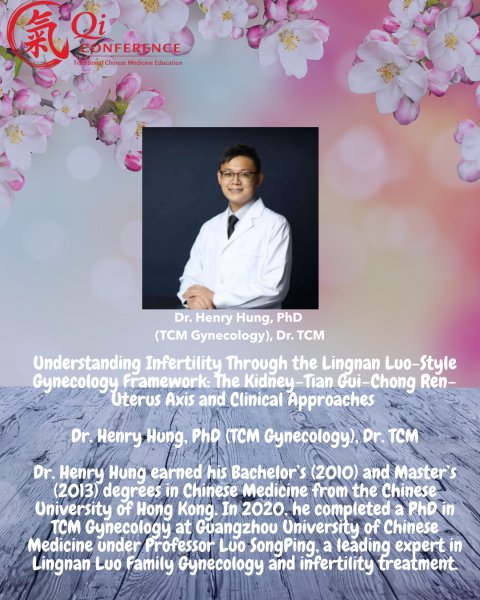
Qi Conference -Understanding Infertility Through the Lingnan Luo-Style Gynecology Framework: The Kidney–Tian Gui–Chong Ren–Uterus Axis and Clinical Approaches
This seminar offers a comprehensive introduction to infertility from the perspective of Lingnan Luo-Style Gynecology. Dr. Henry Hung will present the theoretical foundation developed by Professor Luo Yuankai—the Kidney–Tian Gui–Chong Ren–Uterus axis—and demonstrate how this framework explains the underlying mechanisms of infertility.
The seminar will also cover modern biomedical classifications of infertility and integrate them with Luo-Style pattern differentiation and treatment strategies, providing participants with a clinically relevant and well-rounded understanding of infertility from both traditional and modern perspectives.
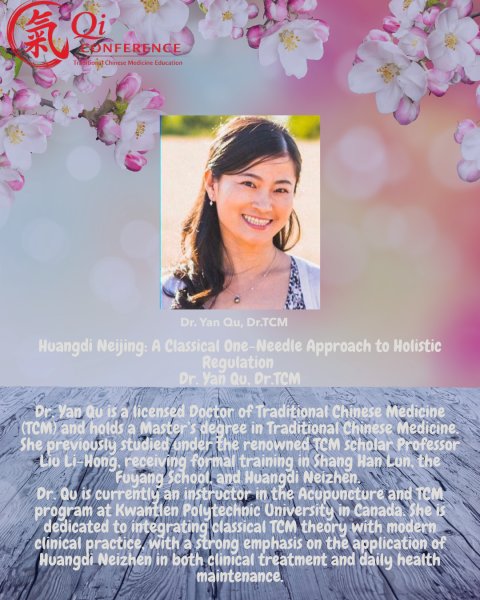
Qi Conference -Huangdi Neizhen: A Classical One-Needle Approach to Holistic Regulation
Huangdi Neizhen is rooted in the holistic medical philosophy of the Huangdi Neijing, with Six-Channel (Liu Jing) Pattern Differentiation serving as its core clinical framework. Emphasizing internal regulation for external disorders and a minimalist needling approach, this method translates classical theory into practical clinical application.
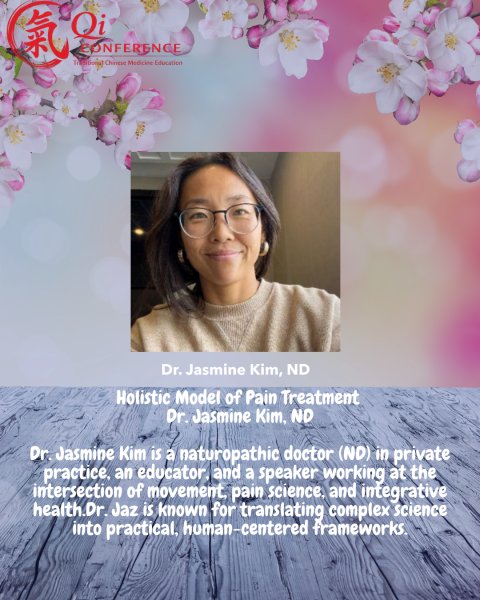
Qi Conference-Holistic Model of Pain Treatment
This presentation explores how both research and lived experience contribute to a more holistic understanding of pain and its management. It traces the evolution from the traditional biomedical model—where pain was viewed primarily as a sign of tissue injury—to the contemporary biopsychosocial model, which recognizes the complex interplay among the nervous system, psychological factors, and social context.