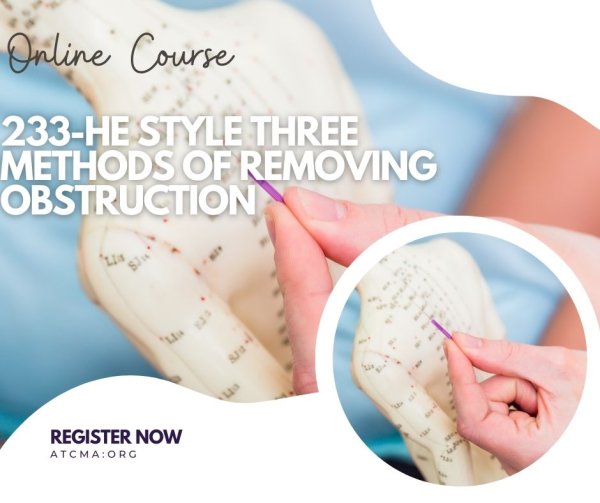
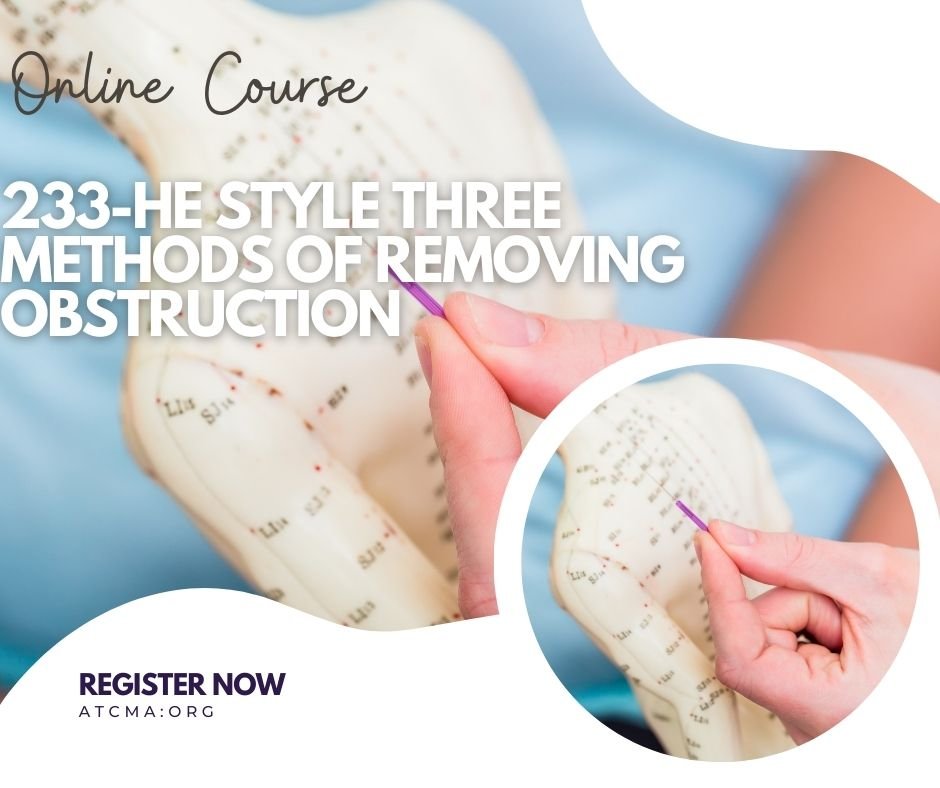
In over 50 years of TCM clinical practice and learning from other's strong points, Professor Puren He summarized and created a unique and effective acupuncture treatment system, named He Style Three Methods of Removing Obstruction.
Details:
- Smeinar Title: He Style Three Methods of Removing Obstruction
- Language: Chinese
- Time: (2 hours)
Abstract:
In over 50 years of TCM clinical practice and learning from other's strong points, Professor Puren He summarized and created a unique and effective acupuncture treatment system, named He Style Three Methods of Removing Obstruction.
Professor He believed that Qi obstruction/stagnation is the main pathogenesis of diseases. After a lot of re-collecting and compiling work of acupuncture, moxibustion, cupping and bloodletting treatment methods, Professor He applied regular needle, warm/fire needle and three-edge needing to remove the all kinds of stagnations and obstructions in the clinical practice, which is also called He Style Three Methods of Removing Obstruction.
Speaker Bio:
Professor Puren He
On November 16, 2010, "Traditional Chinese Medicine Acupuncture" was officially recognized by UNESCO and included in the "Representative List of the Intangible Cultural Heritage of Humanity."
Professor Puren He, a renowned acupuncture expert and a Master of Traditional Chinese Medicine in the capital city, was among the first to be awarded the title of "National Master of Chinese Medicine" by the Ministry of Health and the National Administration of Traditional Chinese Medicine. He is also a designated inheritor of the national-level intangible cultural heritage project in traditional medicine.
Professor He developed the "He Style Three Methods of Removing Obstruction," which combines unique, rapid, and painless needling techniques, skillful fire needle application, and the integration of martial arts, qigong, and acupuncture.
Yali Hu
Yali Hu holds dual degrees in Spacecraft Design from Beihang University and Acupuncture and Tuina from Beijing University of Chinese Medicine. She is a 6th Dan martial artist and has previously served as Deputy Secretary-General and Senior Coach at the Bagua Palm Research Association of the Beijing Wushu Sports Association.
Since 1998, she has systematically studied the He Style Three Methods of Removing Obstruction under Jia Shusen, a direct disciple of Professor Puren He and the President of the Bagua Palm Research Association. She has also practiced medical qigong for health preservation and treatment.
In 2010, Hu passed the Acupuncturist Licensing Examination in British Columbia, Canada, and obtained her Advanced TCM Practitioner qualification in 2013. Since 2014, she has been teaching at the Vancouver Tzu Chi International College of Traditional Chinese Medicine.
Event and Course Registration — Cancellation and Refund Policy
Recorded/On-Demand Online Courses
Once purchased, recorded or on-demand online course content is made available to you immediately. Because access to this digital content begins at the time of purchase, no refunds will be issued for recorded online course purchases, regardless of whether the content has been accessed or completed. This policy is disclosed to you prior to purchase.
Live Events and Courses (In-Person or Live Online)
If you need to cancel your registration for a live event or course, refunds will be issued according to how far in advance ATCMA receives your written cancellation notice, relative to the scheduled date of the event or course:
Notice Received | Refund |
60 days or more before the event/course date | 100% of the amount paid |
30–59 days before the event/course date | 50% of the amount paid |
7–29 days before the event/course date | 25% of the amount paid |
Less than 7 days before the event/course date | No refund |
Cancellation notices must be submitted in writing to info@atcma.org. The date ATCMA receives your notice — not the date it is sent — determines which refund tier applies.
If ATCMA Cancels an Event or Course
If ATCMA cancels a scheduled event or course for any reason, all registered participants will receive a full refund of the amount paid, regardless of the notice periods above. ATCMA is not responsible for any related costs incurred by participants, such as travel or accommodation.
Processing
Approved refunds will be issued within 15 business days of ATCMA receiving your cancellation notice (or of ATCMA's own cancellation of the event/course), using the same payment method originally used, where possible.
Related Courses
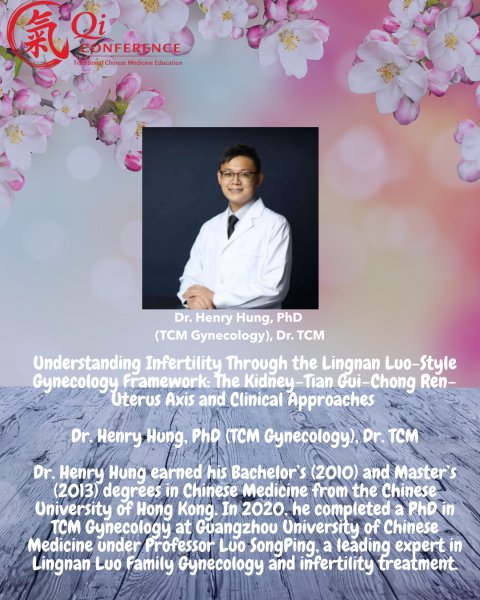
Qi Conference -Understanding Infertility Through the Lingnan Luo-Style Gynecology Framework: The Kidney–Tian Gui–Chong Ren–Uterus Axis and Clinical Approaches
This seminar offers a comprehensive introduction to infertility from the perspective of Lingnan Luo-Style Gynecology. Dr. Henry Hung will present the theoretical foundation developed by Professor Luo Yuankai—the Kidney–Tian Gui–Chong Ren–Uterus axis—and demonstrate how this framework explains the underlying mechanisms of infertility.
The seminar will also cover modern biomedical classifications of infertility and integrate them with Luo-Style pattern differentiation and treatment strategies, providing participants with a clinically relevant and well-rounded understanding of infertility from both traditional and modern perspectives.
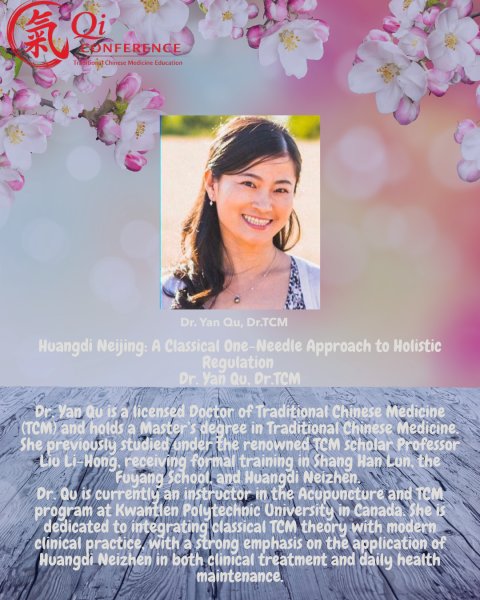
Qi Conference -Huangdi Neizhen: A Classical One-Needle Approach to Holistic Regulation
Huangdi Neizhen is rooted in the holistic medical philosophy of the Huangdi Neijing, with Six-Channel (Liu Jing) Pattern Differentiation serving as its core clinical framework. Emphasizing internal regulation for external disorders and a minimalist needling approach, this method translates classical theory into practical clinical application.
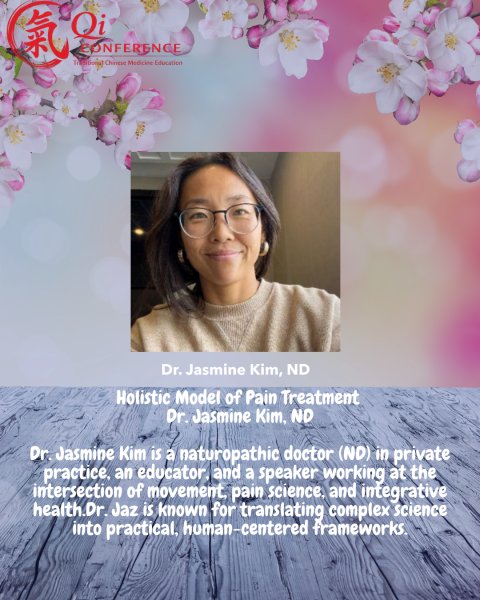
Qi Conference-Holistic Model of Pain Treatment
This presentation explores how both research and lived experience contribute to a more holistic understanding of pain and its management. It traces the evolution from the traditional biomedical model—where pain was viewed primarily as a sign of tissue injury—to the contemporary biopsychosocial model, which recognizes the complex interplay among the nervous system, psychological factors, and social context.